
On the 28th of January last, the headline trumpeted “Guyana registers best ever score on Transparency International ranking.” What will it be this year?
On the 25th of this month, TI will publish around the world its scores for the performance of Governments around the world. The score will contain some surprises. And there will no doubt be questions asked. In that last performance, Guyana was among 22 countries which had improved their score over the previous eight years.
For the first time this year, the CPI will offer a comprehensive look back at a decade in corruption, revealing which countries have improved, regressed or stagnated over the last 10 years. We will also examine how this has impacted human rights and democracy around the world.
The CPI is widely used by the media, academics and businesses. National governments also pay close attention to the results – whether they dread or anticipate the Index’s release from one year to the next.
Take Nigeria, where the president’s office responded acerbically to their low score last year. As our colleagues in the country noted, some of these reactions simply ignored the struggles of people on the ground – those who actually feel the impact of corruption in their daily lives.
In contrast, the government of Kazakhstan celebrated a 4-point increase on the 2020 CPI with a press release. Clearly much more needs to be done in a country which was engulfed by protests over corruption and inequality less than four weeks ago.
There is also Armenia, whose Prime Minister Nikol Pashinyan announced the country’s hopes to increase their CPI score at the Summit for Democracy in December 2021. He should take some pointers from Transparency International Armenia, who note the government’s motivation but flag unfulfilled commitments and the long road ahead.
Readers will no doubt examine the report with several questions in the background of their minds. Some valid questions would be:
- Can any one Guyana government take the credit or blame for the results given the close timing of the change of government to the period under review (2020-2021)?
- What did any government of Guyana do to merit or contribute to whatever score is awarded?
- How did our countries in the neighborhood perform?
- Are the high scores of many countries such as the UK well-deserved given the highly publicized happenings of the Boris Johnson government?
- How are these scores really arrived at?
We will end this short discussion by addressing item 5 immediately. (Articles on the other questions will follow the launch). The score is, first of all, the result of perceptions as it says in the name. So, the question of whose perceptions arises. It is the perceptions of the international community, such as the World Bank, the IDB, etc.
Secondly, it is the perceptions of their dealings with government officials, the public sector. It does not reflect a) dealings with the private sector as recipients of services or goods (And at this point it may be well to clarify that “goods” here is used in the economic sense, and not in its rural Guyanese connotation. Any item that is procured that is not a service is a “good.” Those who understand the struggle we have had to get over the point that “procurement of goods” in the Procurement Act includes petroleum would understand why we make this clarification that some may find unnecessary). Neither does it reflect the perceptions of the private sector, whether local or foreign, who deal with government officials.
And why should anyone care about this index with a high-falutin sounding name? Here’s why. Corruption and impunity contribute to an unsafe climate for human rights defenders to operate in. Out of the 331 cases of murdered human rights defenders in 2020, 98% occurred in 23 countries with high levels of public sector corruption (CPI less than 45). Guyana’s score last time (best ever score, remember?) was 40.
That should give us some food for thought. To remind, here are some comparative figures from last year:
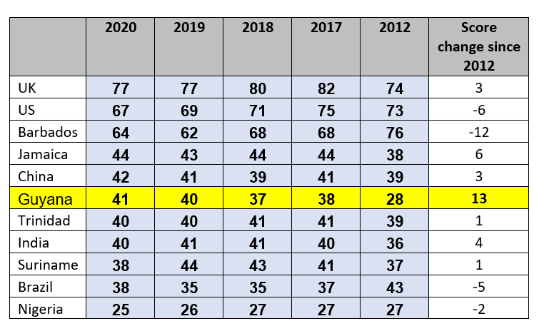
Watch Barbados. In spite of dropping by 12 points over the 9-year period, that country was in the same league as the UK.