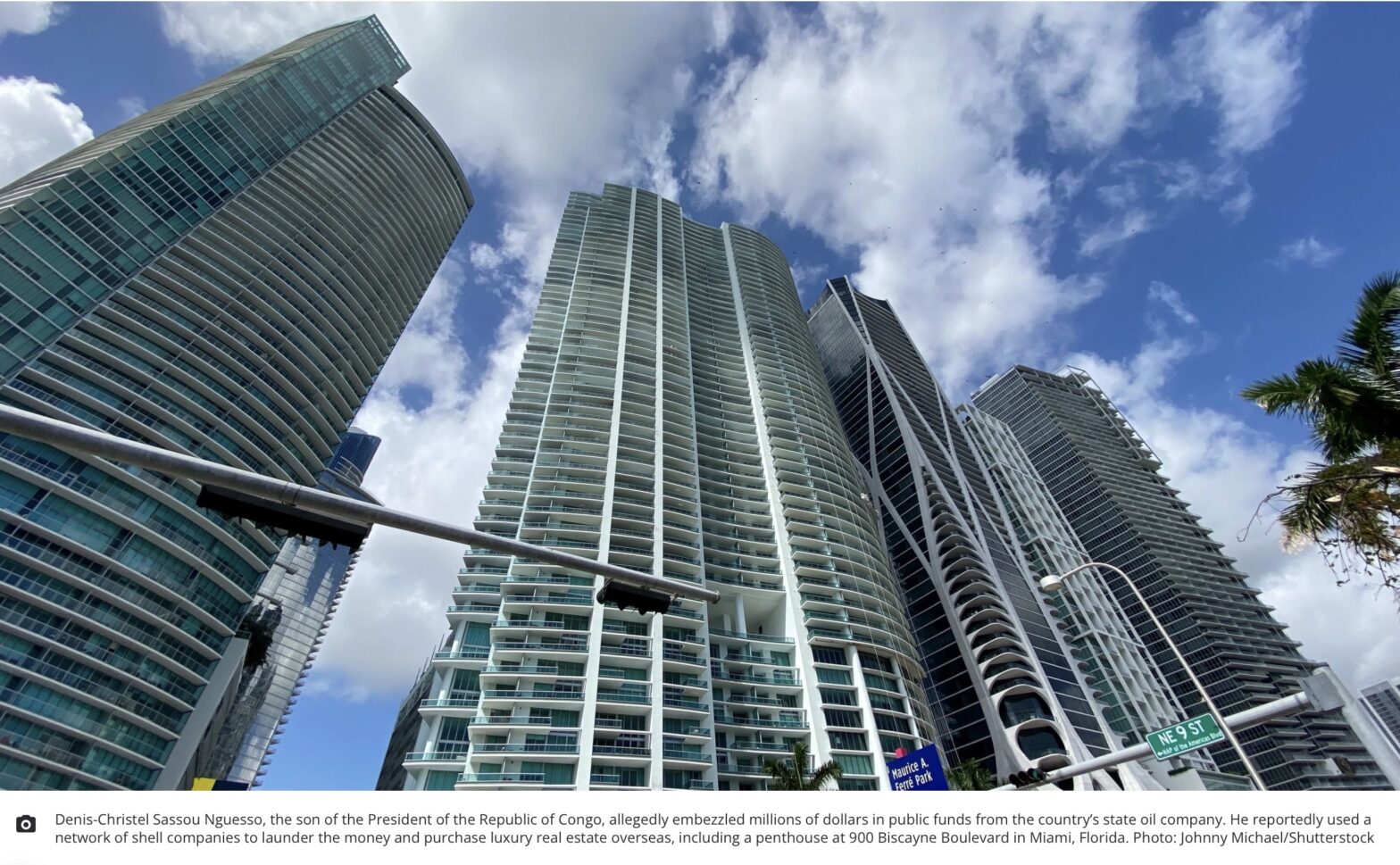
Imagine billions of dollars siphoned from public funds – money meant to build schools, hospitals and infrastructure – vanishing into a web of offshore accounts, luxury real estate and shell companies. This isn’t fiction; it’s the stark reality of how corruption drains resources from Africa and other regions, leaving people to bear the cost.
In our deep-dive analysis of 78 cases, using data available from court records, leaked information, investigative reports and other public sources, we followed the money trail to uncover not only where stolen or hidden funds from Africa end up, but also the mechanisms and tools used to hide them. Our analysis is based on cases of corruption confirmed by court decisions, as well as credible allegations of corruption and hiding of wealth offshore.
Our findings reveal the destinations, methods and assets most commonly used by corrupt actors to launder stolen money. They also highlight the urgent need for action to close these loopholes.
In the part 4 we described how even before Transparency Institute Guyana Inc (TIGI) began to write on the petroleum contract and advocated for insurance to be included in local content (we had not then made representation for oil spill protection as we began to make recently) Berbice fishermen had demanded oil spill insurance. We pointed out that they seemed to have accurately predicted in that meeting, which is now some five years ago, that there would be a decline in the fish catch because of the petroleum-related activities in Guyana’s waters.
We don’t know whether Prof CYT would include them in the “noise and nonsense brigade.” If he were to choose to do so he would have a problem. Their prediction, however they arrived at it, was accurate and simply stated. His predictions are a lot more difficult to understand, being of necessity, done in language too complex at times for the average reader. So he would be unwise to include them in such a classification. And if he does not, he would have to justify calling other people names that he does not call them.
To end this series that is addressed not only to Dr. CYT’s criticism, but to the orchestrated attempt to delegitimize well-meaning civil society voices, we will now proceed to a spectacular battle between civil society and a government. This is a government of one of the most respected countries in the world, whose engineers are famous for their technical competence in matters of sea defence. We are referring, of course, to the Dutch government.
What would have been likely deemed “noise and nonsense” forced an unwilling Dutch government to review its plans. Those plans had already resulted in contracts being signed. But so enormous was the pressure of the “noise and nonsense brigade” that the government had to pay attention and cancel those contracts to address the concerns.
In part 3 we showed that oil companies seemed to have no trouble providing insurance to protect foreign stakeholders and how moral hazard featured in banking, so much so that it helped bring down the financial system in 2007/8. We also showed that the extent of the Deepwater Horizon damage far exceeded “astounding”.
In this part we show that it was the power of the US legal system that made BP pay over US$60 billion for the Deepwater Horizon cleanup. We have no such power and need another mechanism. We also address Prof CYT’s apparent contempt for the court of public opinion.
But let us first clarify a few things as follows: The substance of the call is more than a call for just insurance. This demand is satisfied in what is perhaps the most sophisticated economy in the world and the home of the world’s most famous oil major ExxonMobil.
It is correct that we have called for insurance. However, what we are really after is a guaranteed fund to pay for any damage resulting from a spill. This fund must be available without Guyana having to go after the offending oil company like a mendicant. This can just as well be an escrow account held at an external bank with Guyana and the oil company as signatories. This account can be built up gradually by part of the proceeds from oil. It does not have to be an insurance policy.
(A Transparency Institute Guyana Inc column) (Editor’s note: This is the third instalment in a five-part series. The first two instalments appeared on May 10 and May 11. Stabroek News inadvertently omitted to state that these were TIGI columns.)
In part 1 we showed that insurance companies knew how to mitigate the risk of ‘moral hazard’ so that while the tendency of the insured to benefit financially from information asymmetry existed, it could never ever be enough to frustrate a properly functioning insurance market. In part 2 we presented the quote Dr. CYT should have accessed and included the parts he omitted. These fuller quotes said that one did not need to effect insurance to be affected by moral hazard. We also pointed out that the main ingredient of moral hazard, information asymmetry, was likely at work since the very beginning of Guyana’s relationship with Esso/Exxon.
In Part 1 of our response to Dr. CYT, we pointed out that he had neglected to take into account some fundamental points concerning the nature of the insurance business. We pointed out that, even if the oil company decided to indulge in more risky behaviour as a result of taking out the insurance, the insurance business’ main genius is managing risks all kinds of risks, including moral hazard. They have had over 300 years of development of that expertise!
We also pointed out that, additionally, there would be intrinsic mitigation of any tendency towards riskier behaviour on the part of the insured. We also pointed out that he, having identified the behaviour of the delinquent, appeared to want to place blame on the watchdog rather than where it correctly belonged on the delinquent.
We will now expose the surprisingly poor research he did or the hasty conclusion he drew in order to make his awkward case. This is what he quoted from Investopedia: “when a party to a contract does not have to suffer the potential consequences of a risk the likelihood of a moral hazard increases”
This is what Investopedia actually says:
“What Is a Moral Hazard?
Moral hazard is the risk that a party has not entered into a contract in good faith or has provided misleading information about its assets, liabilities, or credit capacity. In addition, moral hazard also may mean a party has an incentive to take unusual risks in a desperate attempt to earn a profit before the contract settles. Moral hazards can be present at any time two parties come into agreement with one another. Each party in a contract may have the opportunity to gain from acting contrary to the principles laid out by the agreement.” https:// www.investopedia.com/terms/m/moralhazard.asp Now, the reader will notice that Dr. CYT’s version is a rather economical version of what the link to Investopedia provides. The first thing that we notice is that moral hazard can be present in the formation of the contract long before the insurance stage! So even without an insurance policy, the contract can be exposed to moral hazard. Masterclass articles describes it as an information asymmetry problem.
https://www.masterclass.com/articles/what-is-moral-hazard#why-is-moral-hazard-important The trained insurance person immediately notices something wrong with Dr. CYT’s contention. The trained insurance person knows that moral hazard is a good-faith issue first and foremost. He knows that it is usually at play where one party to the contract knows more about the subject of the contract than the other party and uses it to his advantage. For example, the life insurance applicant knows more about his own health than the insurance agent writing the policy does.
The irony of this whole episode is that the entire relationship between Esso/Exxon and Guyana has shown signs of being riddled with information asymmetry, the chief component of moral hazard, from inception but Dr. CYT only recognizes it as potentially at play if insurance is effected. Moral hazard has already wreaked havoc with Guyana! But Dr. CYT does not care to recognize it! All we have to do is recall the now infamous absence of ring fencing in the contract.
Dr. C.Y Thomas, in his column of Sunday 17th April last (https://www.stabroeknews.com/2022/04/17/sunday/guyana and the wider world/critiques-2-3-exxonmobil in the courts of law and public-opinion/) under the guise of a critique of ExxonMobil, continued his ridicule of those of us calling for guaranteed compensation in the form of insurance against any damage to the environment of Guyana and that of our Caribbean sister nations. His words were the following: “By moral hazard I refer to the well-known insurance risk management principle, which states that economic agents who seek protection from risk by way of insurance coverage may well choose to pursue a riskier pattern of behaviour after they are insured! As Investopedia states, the paradox is ‘when a party to a contract does not have to suffer the potential consequences of a risk the likelihood of a moral hazard increases’. Let’s hope the noise and nonsense brigade brings no harm to Guyana by their ill thought out pleadings/pressure for insurance, as ExxonMobil’s behaviour in cutting corners is certainly not comforting.”
Dr. CYT is an elder and economist, well respected among Guyanese and Caribbean academicians and beyond. It is therefore with reluctance that we are forced to pinpoint the logical fallacies of his argument.
He made this fallacious assertion in a season of dismissals of demands made by civil society as “nonsense.” The authority with which Dr. CYT is regarded lends a certain appearance of validity to his claims. This is not a person who was known to have a political purpose in launching feral blasts against civil society before the discovery of oil in Guyana. Nor is he in the race to benefit from the fees, the crumbs falling from Exxon’s table compared to the feast that is rightfully ours if the money comes in fair amounts and goes in the right places not as far as we know.
We have had cause to raise eyebrows at some of Dr. CYT’s en passant observations before but chose to remain silent given his credentials and esteem.
But there are so many problems with his assertion, captured above, that they cannot be left dangling in the minds of the public without response.
Recently, TIGI received a feral blast which is probably the best descriptor given that we have some of the same players from a previous era making similar objections to criticism as when Dr. Luncheon treated us to an object lesson in the use of that term. At that time it was against the American Ambassador.
This time it comes on the heels of criticism of TIGI from VP Jagdeo.
Good relationship with the GOG
Let us be clear from the outset. We do not know which part of the Government of Guyana (GOG) is attacking us as part of the civil society group it finds such a source of irritation. There is a GOG with which we have a quite cordial relationship. This GOG invites us to its consultations and other activities and we respond and attend when we can. We have received invitations from Ms Gail Teixeira, VP Jagdeo and others up to recently.
TIGI will continue to regard our relationship with this GOG as a fruitful one. We were included by GOG in its consultations. We were on Mr. Shyam Nokta’s meeting on the draft local content policy when we made strong representation for insurance and note that insurance has been included on the local content list. We were invited by VP Jagdeo on the forest management consultations and accepted though we were unable to attend.
The trouble is the GOG seems to take on a left brain/right brain schizoid personality. We first noticed this when VP Jagdeo included TIGI for special mention in connection with the Corruption Perceptions Index. TIGI stands by what TI published. But we are not responsible for VP Jagdeo’s or Vice News’ (whoever they are) misinterpretation of the report.
CPI 2021 report was of a congratulatory nature
Believe it or not, the TI report on Guyana and TIGI’s commentary were intended to be of a congratulatory nature. Apparently, no one including the VP himself understood that, although we sent the same press release to all the press media including the Guyana Chronicle. Otherwise, he would have rejected Vice News’ interpretation forthwith. So, how could Guyana drop 2 points in the index and the report be positive? The answer is that those 2 points were not statistically significant. Hence the TI report said “Guyana was at the top of a list of countries that were consistent in showing improvement over the past 5 years” though it remained within the bottom group. That would have included both parties’ period in government.
It may be that whatever was operating in our readers’ heads blocked their minds to that optimistic interpretation. It may well be that the press and others knew of current issues under the surface that could lend a lie to any positive report. We would not be surprised. We receive reports all the time. But those issues, if they show up in the CPI, will affect the perceptions report for 2022, not 2021.
Transparency Institute Guyana Inc. (TIGI) is just one of the many agencies that has over the years registered concerns about unsettling matters that remain unaddressed as regards the effective management of the local oil and gas sector. The transparency body is however looking to take their advocacy a bit further as it intends to press the Caribbean Community (CARICOM) on their silence regarding oil and gas matters in Guyana that have the potential to adversely affect the region. In a recent TIGI column, the transparency agency noted that while local authorities here seem to be shunning persons and organizations who criticize their handling of the oil sector, it is also notable that CARICOM seems not to be focusing on the potential dangers that it too faces where certain decisions are made in the local industry. “We have some more questions to ask but not of the (Government of Guyana) GOG. We have a certain regional organization to ask whether the Treaty of Chaguaramas envisioned that one country would be able to sign contracts with multinationals that expose the entire region’s people and tourism industry to such high levels of risk without guaranteed compensation.” TIGI was at the time referencing the contractual agreements made between Guyana, US-based oil giant Exxon Mobil and its subsidiary agencies for the pumping of the country’s offshore oil reserves. Civil society bodies like TIGI and other concerned parties have highlighted a number of grey areas that include environmental concerns, tax payment concerns, local content concerns and the sharing of oil profits among other matters. TIGI is of the firm conviction that one of the most obvious arrangements that should concern CARICOM is the failure of Guyanese leaders to ensure that ExxonMobil would take responsibility for all costs associated with the unfortunate occurrence of an oil spill caused by its subsidiary, Esso Exploration and Production Guyana Limited (EEPGL). Instead, should such an unwanted situation occur, EEPGL which is the operator of the Stabroek Block, and is in partnership with the subsidiaries of Hess Corporation and CNOOC Group, would be responsible for handling the cleanup costs. Importantly, these companies would be unable to provide Guyana with full coverage insurance that would ensure all costs associated with an unmitigated oil spill would be completely taken care of. Additionally, the money expended by the limited liability companies would be recoverable from Guyana if the oil producing nation fails to prove the environmental disaster resulted from “gross negligence.” With Guyana playing an integral role within the Caribbean bloc and being in proximity to its CARICOM neighbours, TIGI believes that small islands that depend on fishing, tourism and other such commercial activities could be directly affected and as such, should express concerns. In the same way that the Guyana government is asking civil society where they have been as they have been selective in their criticism of the government, TIGI said, “The people of Guyana should be asking them (CARICOM) where they have been. Why have they been silent?” TIGI indicated that CARICOM is run by funds coming from the peoples of the region and the Bloc should thus have a bigger interest in matters that could affect them.
The Transparency International Corruptions Perceptions Index has now been released around the world as of 6:00 a.m. Central European Time.
Governments around the world will be watching the score to see if it reflects well on them or not, even if they pretend not to notice. So let us get to the results right away. We have a pleasant surprise. Last year Guyana was among 22 countries which had improved their score over the previous eight years.
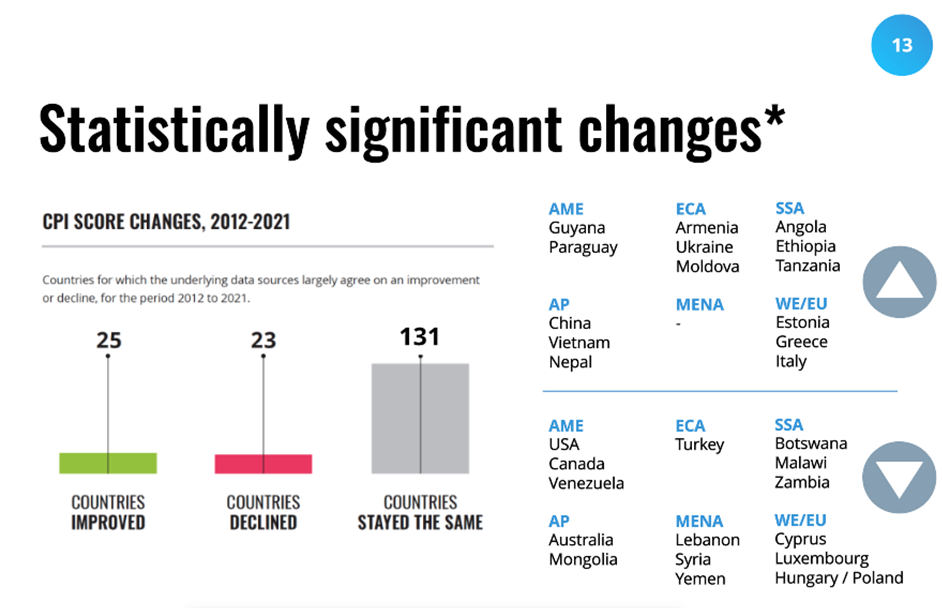
This year Guyana tops the list of countries that have made significantly positive improvements!
Bear in mind that the higher the score the better the performance.
Here is the list of countries that have had a significant level of improvement since 2012:
(AME = Americas, AP = Asia Pacific, MENA, Middle East/North Africa, SSA = Subsaharan Africa, WE/EU = Western Europe/European Union)
While Guyana has shown improvement it will be obvious that we are still among the worst performing countries of the world.
For the first time this year, the CPI will offer a comprehensive look back at a decade in corruption, revealing which countries have improved, regressed or stagnated over the last 10 years. We also examine how this has impacted human rights and democracy around the world.
The CPI is widely used by the media, academics and businesses. National governments also pay close attention to the results – whether they dread or anticipate the Index’s release from one year to the next.
Take Nigeria, where the president’s office responded acerbically to their low score last year. As our colleagues in the country noted, some of these reactions simply ignored the struggles of people on the ground – those who actually feel the impact of corruption in their daily lives.
In contrast, the government of Kazakhstan celebrated a 4-point increase on the 2020 CPI with a press release. Clearly much more needs to be done in a country which was engulfed by protests over corruption and inequality less than four weeks ago.
There is also Armenia, whose Prime Minister Nikol Pashinyan announced the country’s hopes to increase their CPI score at the Summit for Democracy in December 2021. He should take some pointers from Transparency International Armenia, who note the government’s motivation but flag unfulfilled commitments and the long road ahead.
Readers will no doubt examine the report with several questions in the background of their minds. Some valid questions would be:
Can any one Guyana government take the credit or blame for the results given the close timing of the change of government to the period under review (2020-2021)?
What did any government of Guyana do to merit or contribute to whatever score is awarded?
How did our countries in the neighborhood perform?
How are these scores really arrived at?
We will end this short discussion by addressing item 4 immediately. (Articles on the other questions will follow the launch). The score is, first of all, the result of perceptions as it says in the name. So, the question of whose perceptions arises. It is the perceptions of the international community, such as the World Bank, the IDB, etc.
Secondly, it is the perceptions of their dealings with government officials, the public sector. It does not reflect a) dealings with the private sector as recipients of services or goods (And at this point it may be well to clarify that “goods” here is used in the economic sense, and not in its rural Guyanese connotation. Any item that is procured that is not a service is a “good.” Those who understand the struggle we have had to get over the point that “procurement of goods” in the Procurement Act includes petroleum would understand why we make this clarification that some may find unnecessary). Neither does it reflect the perceptions of the private sector, whether local or foreign, who deal with government officials.
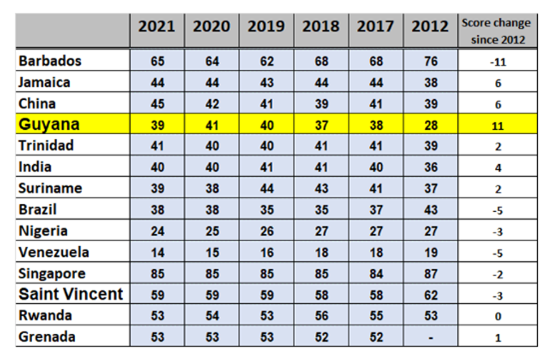
And why should anyone care about this index with a high-falutin sounding name? Here’s why. Corruption and impunity contribute to an unsafe climate for human rights defenders to operate in. Out of the 331 cases of murdered human rights defenders in 2020, 98% occurred in 23 countries with high levels of public sector corruption (CPI less than 45). Guyana’s score last time (best ever score, remember?) was 40.
Here are some other countries for comparison:
TIGI hopes to discuss this index in some of its upcoming articles.
On the 28th of January last, the headline trumpeted “Guyana registers best ever score on Transparency International ranking.” What will it be this year?
On the 25th of this month, TI will publish around the world its scores for the performance of Governments around the world. The score will contain some surprises. And there will no doubt be questions asked. In that last performance, Guyana was among 22 countries which had improved their score over the previous eight years.
For the first time this year, the CPI will offer a comprehensive look back at a decade in corruption, revealing which countries have improved, regressed or stagnated over the last 10 years. We will also examine how this has impacted human rights and democracy around the world.